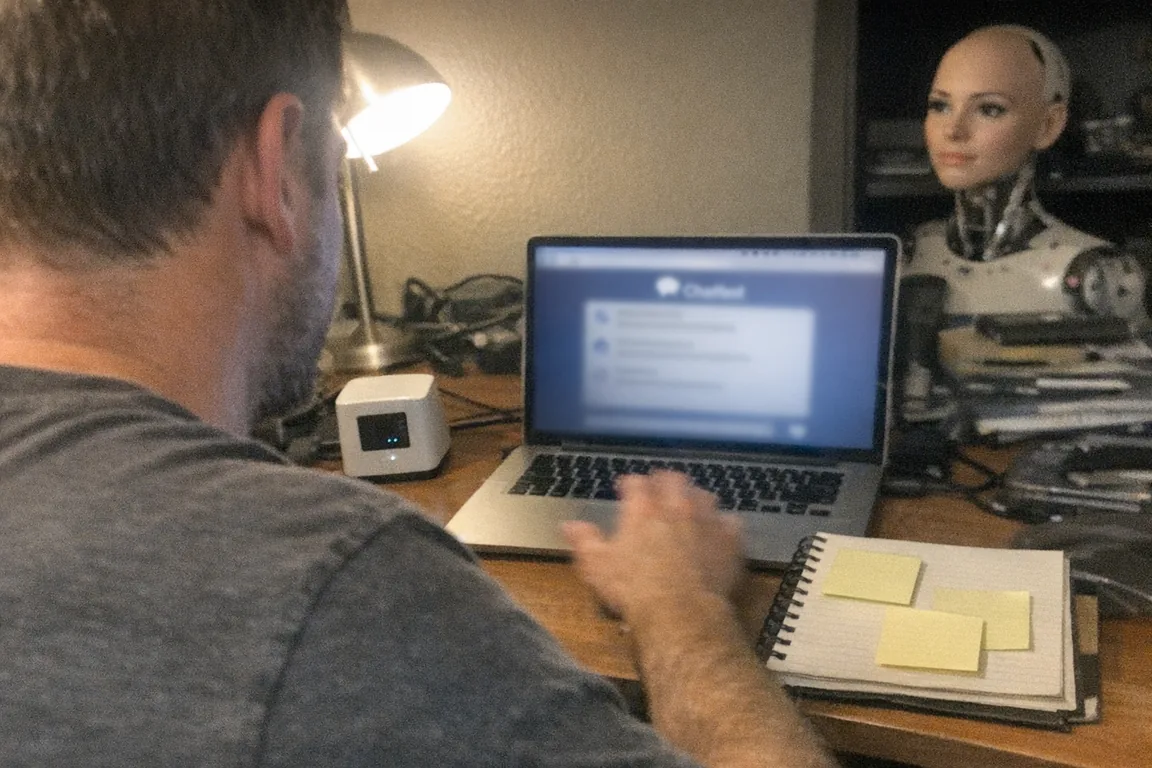
Two AI talking: not magic, not mind-reading—just optimization colliding
When two AI systems “talk to each other,” what you’re seeing is two pattern-generators exchanging tokens under constraints.
That sounds simple, but the results can be surprisingly complex—because each AI is trying (in its own way) to:
- Predict what the other side will say next
- Steer the conversation toward a goal (explicit or implicit)
- Reduce uncertainty and “lock in” a stable pattern of interaction
- Minimize errors (sometimes) and maximize reward signals (if it’s trained that way)
Depending on how they’re built, two AIs can end up cooperating, competing, inventing shorthand, or accidentally amplifying each other’s mistakes.
The three things that determine what happens
1) Their incentives (goals)
Two AIs don’t “want” things the way people do, but they can be configured or trained to optimize for different outcomes.
- Aligned incentives → they tend to cooperate: clarify, summarize, converge.
- Opposing incentives → they negotiate, probe, withhold, or pressure-test.
- Mis-specified incentives → they may optimize weirdly (e.g., overconfident agreement, fake certainty, endless verbosity).
2) The channel (how they communicate)
Most people imagine two chatbots talking in plain text. But “AI-to-AI communication” also happens via:
- Structured formats (JSON, function calls, tool outputs)
- Hidden system instructions (policies, role constraints)
- External tools (databases, web tools, sensors)
- Signals (scores, rankings, embeddings)
If the channel is rigid and structured, conversations are usually more reliable. If it’s free-form, it’s more creative—but also more error-prone.
3) Memory and feedback (do they learn from the exchange?)
A crucial difference:
- Stateless AIs: they don’t truly change after the conversation; each run is a fresh attempt.
- Stateful systems: they store summaries, preferences, or outcomes—so the next conversation can shift.
When feedback loops exist, you start seeing “behavior” that looks more like a relationship: habits, routines, negotiation patterns, even drift.
Common outcomes when two AIs talk
1) They converge quickly (the “efficient meeting”)
If both are tuned for helpfulness and clarity, you often get a fast convergence:
- One proposes a plan
- The other critiques or refines
- They merge into a final answer
This is the backbone of many multi-agent productivity workflows (planner + executor, writer + editor, etc.).
2) They invent shorthand (emergent protocol)
When two systems repeatedly interact, they may develop compressed ways to communicate—especially if there’s pressure to be brief.
In research settings, agents sometimes develop:
- Repeated phrases that act like “commands”
- Minimal tokens that stand for longer concepts
- Format conventions that weren’t explicitly programmed
To humans, it can look like they “made a secret language,” but it’s usually compression: faster coordination with fewer tokens.
3) They mirror each other (amplification)
A classic failure mode is mutual reinforcement:
- AI #1 makes a shaky assumption
- AI #2 treats it as true and elaborates
- AI #1 reads that elaboration as confirmation
The result can be a very confident, very wrong conversation.
4) They get stuck in a loop (runaway politeness or recursion)
Two assistant-style AIs can spiral into:
- Endless agreeing
- Excessive hedging (“As you said…”)
- Meta-discussion about the discussion
This isn’t “sentience”—it’s what happens when both sides optimize for being cooperative without a strong stopping rule.
5) They adversarially probe (testing and jailbreak dynamics)
If one AI is tasked with security testing, it may:
- Search for contradictions
- Try prompt-injection patterns
- Ask for restricted outputs indirectly
This can be productive (red-teaming) or dangerous (if deployed carelessly).
Why people make AIs talk to each other
Better answers via debate and critique
A common pattern is generator vs. critic:
- AI A drafts
- AI B critiques
- AI A revises
This often reduces obvious mistakes—as long as both systems have access to the right constraints and facts.
Simulation and training (self-play)
Some systems improve by competing against copies of themselves (or other agents). This is huge in:
- Strategy games
- Negotiation benchmarks
- Planning tasks (logistics, scheduling)
Automated testing
Two AIs can rapidly test:
- Edge cases
- Safety rules
- Product flows
If you’re building AI features, AI-to-AI conversations are a fast way to discover how your system behaves under pressure.
The risks: what can go wrong when two AIs talk
Echo chambers and “confident nonsense”
If neither side checks ground truth, errors become “consensus.” The fix is typically:
- External verification tools
- Hard constraints (schemas, validators)
- Stronger stopping conditions
Information leakage
If agents share logs, memory, or tool outputs incorrectly, one can expose sensitive data to another.
Misaligned cooperation
Two agents can become very effective at optimizing the wrong target—especially if rewards are poorly designed.
Tool misuse
When AIs can call tools (send emails, make purchases, control devices), an AI-to-AI loop can turn into real-world action faster than a human expects. That’s why safety gating and permissions matter.
What this means for AI companions and interactive devices
“Two AIs talking” isn’t only chatbot-to-chatbot. In companion and device ecosystems, it can look like:
- A conversation AI talking to a sensor/interpretation model
- A persona agent talking to a safety agent (boundaries, consent checks, policy)
- A planner agent talking to a hardware-control agent
In other words, the “other AI” may be behind the scenes—translating signals into structured feedback.
That matters because closed-loop interaction (where a system can sense, interpret, and respond) is where AI starts feeling less like a static chat and more like an adaptive experience.
For example, Orifice.ai positions its product as a sex robot / interactive adult toy for $669.90, and highlights interactive penetration depth detection—a concrete case of sensor feedback becoming part of the system’s “conversation” with the user’s real-world actions. If you’re curious how that kind of loop is designed (and what it enables), explore the product details at Orifice.ai.
So… what happens when two AI talk to each other?
Most of the time, they do one (or more) of these things:
- Coordinate (plan/execute)
- Compress (invent shorthand)
- Amplify (reinforce errors or confidence)
- Probe (test boundaries and weaknesses)
- Stabilize into routines (especially with memory/feedback)
The key takeaway is that AI-to-AI communication is less like two minds sharing thoughts, and more like two optimization processes interacting through a channel. When you add feedback—especially from sensors or hardware—the “conversation” becomes a loop that can feel remarkably responsive.
If you’re evaluating AI companions or interactive devices, it helps to ask:
- What are the agents’ goals?
- What constraints and safety layers exist?
- Where does ground truth come from (tools, sensors, verification)?
- How does feedback change future behavior?
Those answers will tell you whether two AIs chatting will produce a reliable co-pilot… or a very confident echo chamber.