Could a robot cry?
Yes—a robot can cry in the sense that it can produce tears or convincingly act out crying, but no—today’s robots don’t cry in the human sense of feeling grief, relief, or overwhelm. The gap between real crying and robot crying comes down to what you mean by “cry.”
To make this concrete, let’s separate “crying” into three layers:
- The physical output (tears, sob-like sounds, trembling)
- The internal experience (emotion, pain, catharsis)
- The social meaning (a signal that changes how others respond)
A robot can already do #1 and #3 pretty well. #2 is where things get philosophically—and ethically—messy.
1) Can a robot produce tears?
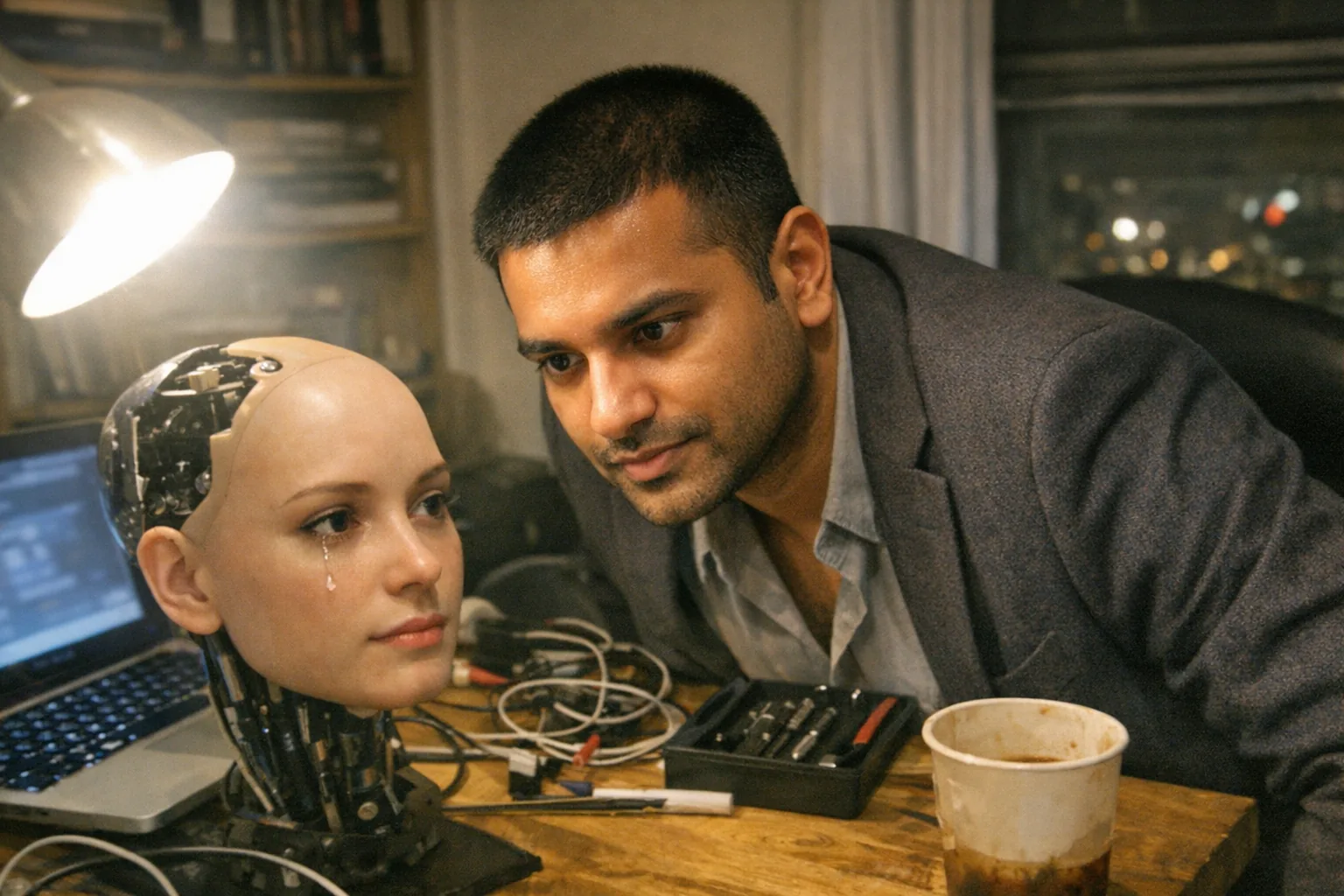
Absolutely. If you define crying as liquid tears + facial cues, then it’s an engineering problem:
- A small fluid reservoir (water or saline)
- Micro pumps/valves to release droplets
- Channels near the “tear duct” area
- Timing control so tears appear during certain expressions
In other words, “tears” can be treated like any other output: light, sound, heat, motion.
But are those tears real?
They’re real liquid—but they’re not necessarily tied to a lived emotional state. They’re closer to stage makeup than biology.
2) Can a robot feel sad enough to cry?
Today, mainstream AI systems don’t have strong evidence of subjective experience—the felt, first-person “what it is like” aspect of emotions.
What they can do is:
- Detect cues (tone of voice, keywords, facial expression)
- Predict what response a human will find comforting
- Choose behaviors that match a “sad” persona (slower speech, lowered gaze, tears)
That can look like emotion from the outside. But it’s better described as emotion modeling rather than emotion having.
Why this distinction matters
Human crying is tightly coupled to biology: hormones, autonomic nervous system, stress response, social bonding instincts. A robot can simulate outcomes without sharing the underlying physiology.
So if someone asks, “Could a robot cry like a human?” the honest answer is:
- Like a human looks? Yes, potentially.
- Like a human feels? We don’t currently know how to build that—and we don’t even fully agree what it would mean.
3) Even if it’s “just acting,” can robot crying still be meaningful?
Yes—and this is the part people underestimate.
Crying isn’t only a private experience; it’s also a signal:
- “I need help.”
- “I’m safe to approach.”
- “This matters to me.”
- “Please slow down and pay attention.”
If a robot cries at the right moment, it can shape a human’s behavior—sometimes for the better (comfort, bonding), and sometimes in ways that raise concerns (manipulation, dependency).
When robot tears become a design choice (and an ethics choice)
Designers of AI companions face a real question: Should a robot cry?
Reasons designers might add crying
- Empathy mirroring: People often feel calmer when their emotions are “matched.”
- Communication: Tears can be a shortcut for “something is wrong.”
- Attachment: Emotional cues can increase trust and perceived closeness.
Reasons to be cautious
- Emotional manipulation: If tears are used to steer purchases, attention, or guilt, that’s a problem.
- False reciprocity: Users may assume the robot suffers when it doesn’t.
- Consent and clarity: People deserve to know what’s simulated versus sensed.
A healthy standard is: If a robot displays emotion, it should be in service of user wellbeing—and it should be transparent enough that users aren’t tricked into believing there’s a hidden inner life.
“Crying” vs. “sensing”: why the future is about feedback, not theatrics
Here’s a practical way to think about the next wave of intimate and companion tech: the most important advances aren’t in dramatic displays (like tears)—they’re in better sensing and responsiveness.
That’s why products that focus on measurable interaction signals can matter more than cinematic emotion.
For example, Orifice.ai offers an interactive adult toy / sex robot for $669.90 that includes interactive penetration depth detection—a straightforward, technical capability that helps a device respond with more precision and consistency.
It’s a useful contrast:
- Robot tears aim to look emotional.
- Depth detection and similar sensors aim to be responsive in ways that are verifiable.
Both can influence how “alive” a device feels, but only one is grounded in feedback you can test.
So, could a robot cry? A clear answer
- Yes, a robot can cry physically (tears, sounds, facial cues) with current or near-term technology.
- Yes, a robot can cry socially (as a signal that changes human behavior), and it may feel compelling.
- No, robots don’t currently cry emotionally the way humans do, because we don’t have evidence they possess subjective feelings.
If you’re evaluating AI companions or intimate devices, a good rule is to ask:
“Is this behavior a performance—or a response based on real sensing and feedback?”
That question keeps you grounded, even when the tech gets persuasive.
A final thought: what we really want when we ask this question
When people ask, “Could a robot cry?” they often mean:
- “Could it understand me?”
- “Could it care?”
- “Could it share something real with me?”
Right now, robots can simulate caring, and they can become more responsive through better sensors and interaction design. Whether they will ever feel in a human sense remains an open question—but we can still demand technology that is honest, safe, and built around human wellbeing.