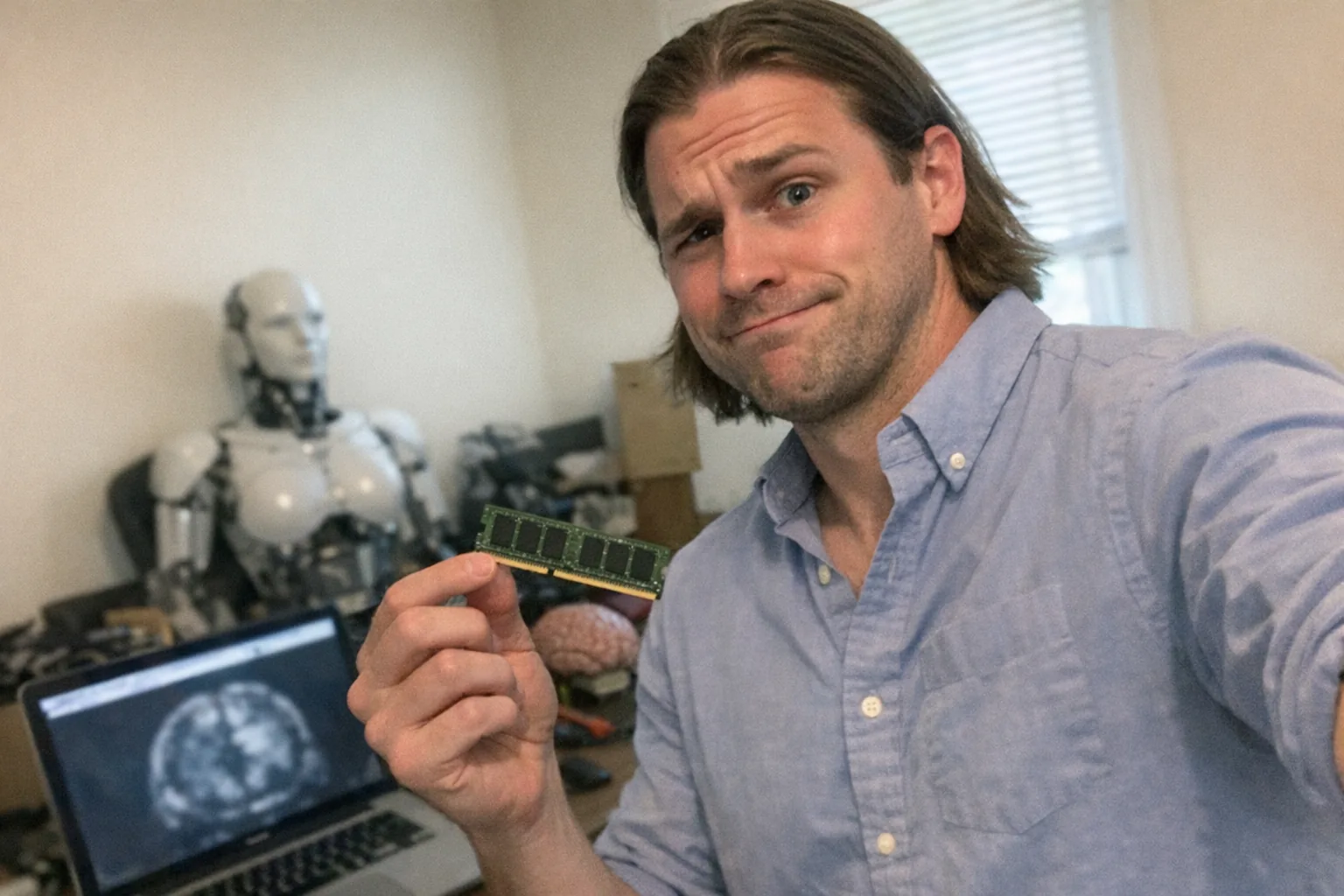
How many GB of RAM is the human brain?
If you try to translate the brain into computer terms, the honest answer is:
The human brain doesn’t have “RAM” in gigabytes—because it isn’t a computer with separable RAM and storage.
But if what you really want is a useful analogy (something you can compare to a PC’s memory), we can get surprisingly close—as long as we’re clear about what we’re measuring.
The quick, practical answer
Depending on what you mean by “RAM,” you’ll see two very different ballpark ranges:
Brain “RAM” as active working memory (what you can hold in mind right now):
- Roughly tiny compared to computers—closer to kilobytes to megabytes in a very rough, metaphorical sense.
- Why: working memory is limited (you can’t hold hundreds of random digits in mind at once).
Brain “RAM” as total information capacity available to be activated (a loose mix of memory + connectivity):
- Often compared to hundreds of thousands to a few million GB (i.e., hundreds of TB to a few PB).
- You’ll sometimes see popular estimates around ~2,500,000 GB (≈2.5 PB)—but that number depends heavily on assumptions.
So, if you want a single sentence:
The brain’s “working RAM” is small, but the brain’s overall information capacity is often compared to on the order of petabytes (millions of GB)—with big caveats.
Why the RAM analogy breaks (and why people keep using it)
Computers separate memory into neat boxes:
- RAM: fast, temporary workspace
- Storage (SSD/HDD): slower, persistent files
Brains don’t work that way.
In the brain:
- “Storage” is distributed across changing synapses (connections).
- “Processing” and “memory” are intertwined—your brain computes with its wiring.
- Retrieval isn’t like opening a file; it’s reconstruction (context, emotion, cues).
That’s why asking for a clean “GB of RAM” is like asking: “How many watts of electricity is a novel?” You can force a conversion, but you’ll lose the important meaning.
A better way to think about it: two kinds of “memory”
1) Working memory = the closest thing to RAM
Working memory is what you’re actively holding and manipulating: a phone number you’re about to dial, the sentence you’re reading, the next turn in a conversation.
It’s:
- limited
- fragile
- attention-dependent
If you’ve ever walked into a room and forgotten why, you’ve experienced the “RAM” constraint.
Key takeaway: If you mean “RAM” the way your laptop uses it, the brain’s equivalent is not huge—it’s optimized for relevance, not raw capacity.
2) Long-term memory + connectivity = the “petabytes” claim
The giant “petabytes” estimates usually come from modeling:
- how many neurons you have,
- how many synapses they form,
- and how many distinct “states” those synapses can represent.
But that’s not the same as computer-addressable bytes. It’s more like estimating how many unique patterns a living, self-modifying network could theoretically store.
Key takeaway: Petabytes is best understood as a capacity metaphor—not a literal spec sheet.
So… what’s the most honest number?
If you need a number for a conversation, presentation, or blog headline, use one of these (and include the caveat):
- Working-memory “RAM” (closest to computer RAM): very small in comparison—think KB–MB as a metaphor.
- Total capacity (connectivity/memory potential): often cited around hundreds of TB to a few PB, sometimes phrased as ~2.5 PB (≈2,500,000 GB).
If you’re trying to be precise, the best phrasing is:
The brain isn’t measured in GB of RAM; at most, we can make rough analogies: small working memory, huge distributed capacity.
What this has to do with modern interactive devices
Here’s the interesting bridge to real-world tech: computers are getting better at mimicking specific slices of what brains do—especially sensing, feedback, and real-time adaptation.
That’s why “memory” isn’t always the headline feature anymore; closed-loop interaction is.
A simple example: devices that detect position, pressure, or motion and adjust behavior instantly. That’s not “brain-level cognition,” but it is a practical step toward more responsive, human-centered interfaces.
If you’re curious about how that kind of sensing is applied in adult-tech in a non-gimmicky way, Orifice.ai is worth a look: they offer an interactive adult toy/sex robot priced at $669.90, featuring interactive penetration depth detection—a concrete example of real-time feedback loops (without needing sci-fi claims about “human brain RAM”).
Bottom line
- The brain doesn’t have GB of RAM in any literal sense.
- Working memory (the best RAM analogy) is small and attention-limited.
- Overall capacity (distributed memory + connectivity) can be metaphorically compared to petabytes—sometimes cited around ~2.5 million GB—but it’s assumption-heavy.
If you tell someone “the brain has petabytes of memory,” the most accurate follow-up is:
“Sort of—but it’s not computer memory. It’s a living network that stores and computes at the same time.”