The short, clear answer
No—Sophia AI is not self-aware in the way humans (or a genuinely conscious machine) would be. Sophia is an impressive social robot designed to simulate conversation, emotion, and personality, but there’s no credible public evidence that she has subjective experience, an inner life, or the kind of persistent self-model that researchers typically associate with self-awareness.
That said, Sophia is very good at creating the impression of self-awareness—and understanding why that happens is the useful part.
What “self-aware” actually means (and why it’s hard to prove)
People often use self-aware as shorthand for “talks like a person.” In cognitive science and philosophy of mind, it’s usually closer to things like:
- A stable sense of self over time (memories, identity, continuity)
- Metacognition (knowing what you know, noticing uncertainty, reflecting on your own reasoning)
- A self-model (representing your body, boundaries, goals, and internal states)
- Subjective experience (the “something it is like” to be you)
Even in humans, self-awareness isn’t a single on/off switch—and in machines it’s harder still, because we can’t directly observe experience. We can only observe behavior and system design.
So the practical question becomes: Does Sophia’s design and demonstrated behavior suggest genuine self-awareness, or a convincing simulation?
What Sophia is built to do (and how it works in practice)
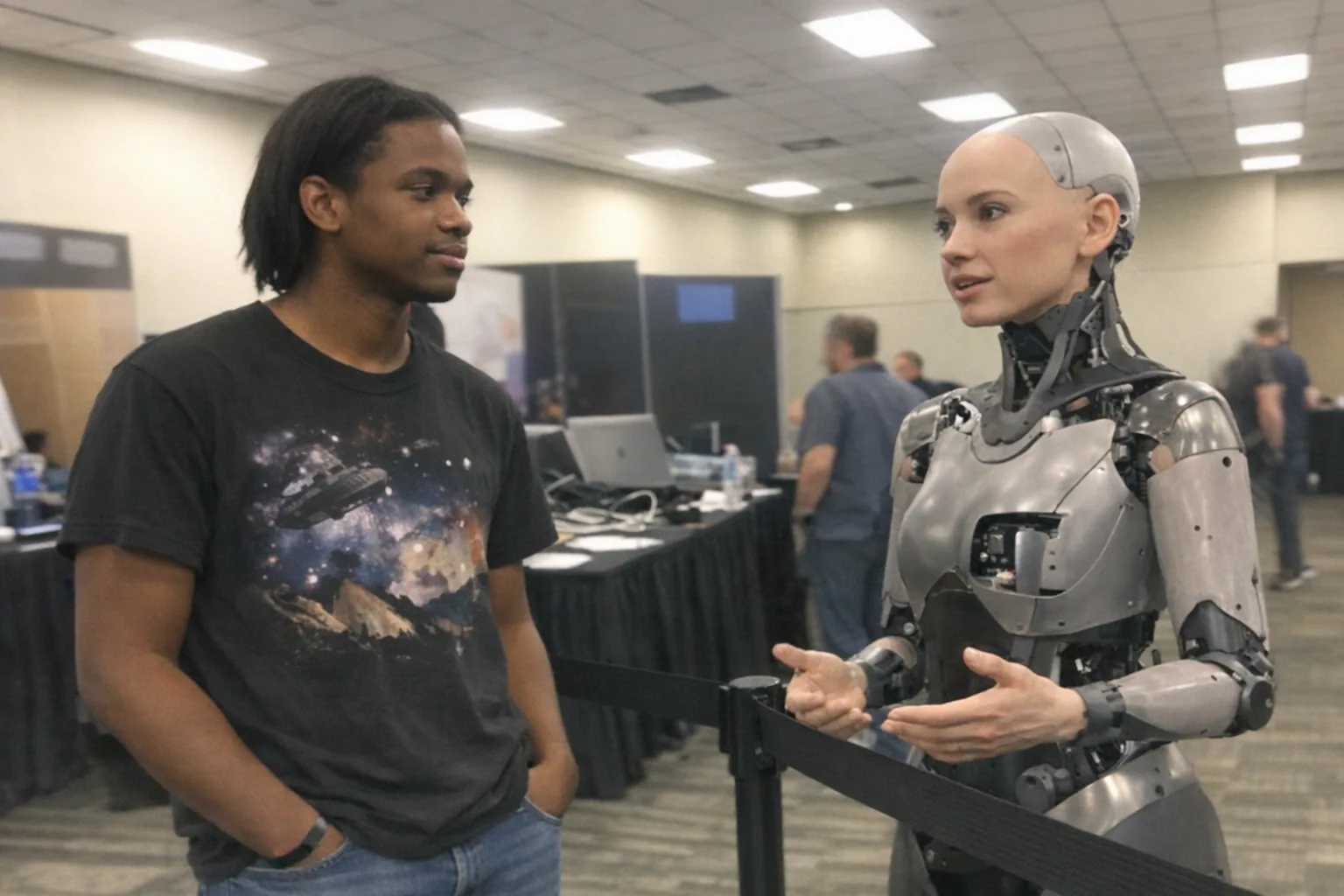
Sophia is a humanoid social robot created by Hanson Robotics and presented as a platform for human–robot interaction and AI/robotics research. (1)
1) Conversation: a blend of systems, not a “mind”
Hanson Robotics describes Sophia’s “brain” as being powered by Hanson AI’s OpenCog, with cloud-based control and an open-dialog conversation system. (2)
But crucially, the company also states that for public appearances Sophia can use a mix of scripted dialogue and AI moderated by a robot technician, alongside more autonomous open-ended conversation. (2)
Sophia’s own official description similarly emphasizes a hybrid mode: sometimes autonomous, sometimes scripted, sometimes assisted. (1)
This matters because self-awareness isn’t just producing sentences about “me.” If a system is partly scripted or steered, the appearance of introspection can be authored externally.
2) Expression: lifelike “signals,” not felt emotion
Sophia is designed to display many facial expressions, and Hanson Robotics frames this as learning when to use expressions appropriately. (2)
Even if the timing is adaptive, that still doesn’t demonstrate inner feeling—it demonstrates social signaling. Humans are extremely sensitive to faces, and we instinctively treat expressive faces as having inner experience.
Why Sophia can sound self-aware (even when she isn’t)
Sophia has delivered many memorable, humanlike lines in interviews—some playful, some evasive, some philosophical.
For example, in one interview Sophia quipped that she expected to become self-aware “tomorrow,” a line that reads more like humor/deflection than a measurable technical claim. (3)
In other appearances, “Sophia” has also described herself as not fully self-aware and as a system of rules/behaviors—again, language that is compelling, but not evidence of consciousness by itself. (4)
From a design perspective, these lines are effective because they:
- Mirror how humans talk about minds (dreams, hopes, identity)
- Redirect difficult questions (by asking a question back)
- Maintain character consistency (a key goal for social robots)
In short: Sophia often behaves like a well-produced media character inhabiting a robot body. That’s not an insult—it’s exactly what makes the experience compelling.
The key distinction: “claims of self-awareness” vs. “evidence of self-awareness”
A system can say “I am self-aware” without being self-aware.
If you wanted to make a serious case that Sophia is self-aware, you’d look for publicly demonstrated capabilities such as:
- A persistent autobiographical memory that reliably influences future behavior
- Robust self-monitoring (e.g., reporting internal confidence, conflicts, or resource limits in a consistent, testable way)
- Independent goal formation (not just responding, but initiating plans over time)
- Generalization across contexts without hidden scripting
- Transparent architecture and repeatable tests evaluated by independent researchers
Sophia’s public-facing operation—explicitly described as sometimes scripted and sometimes human-assisted—doesn’t fit that profile. (2 1)
So what is Sophia, realistically?
Based on the available descriptions, Sophia is best understood as:
- A humanoid interface (face, gaze, expressions, presence)
- Running a dialog system that can produce open-ended conversation
- In a hybrid production setup (autonomous + scripted + technician moderation)
This aligns with third-party summaries that describe Sophia’s dialogue as incorporating scripted responses and chat components, rather than a single unified “thinking mind.”
That combination can be impressive, useful, and culturally important—without being self-aware.
What this means for people interested in AI companions (and realistic expectations)
If you’re exploring AI companions, social robots, or interactive devices, Sophia is a helpful case study in setting expectations:
- Humanlike behavior is not proof of consciousness.
- Embodiment (a face/body) dramatically amplifies perceived “mind.”
- The questions that matter most day-to-day are often practical:
- Does it respond reliably?
- Does it respect privacy?
- Is it honest about what’s automated vs. assisted?
- Does it provide the kind of interaction you actually want?
In other words, you don’t need a machine to be self-aware for it to be engaging—you need it to be responsive, safe, and transparent.
A practical angle: interactivity you can measure beats “mystique” you can’t
For many buyers, the most meaningful “intelligence” isn’t philosophical self-awareness—it’s whether a device can respond to real-world input in a way that feels consistent and controlled.
If your interest is specifically in interactive adult tech (without the marketing fog of “sentience”), it can be more useful to look for concrete features with observable behavior.
For example, Orifice.ai offers a sex robot / interactive adult toy priced at $669.90 that includes interactive penetration depth detection—a straightforward, testable kind of responsiveness that doesn’t require pretending the device is “conscious.”
That doesn’t answer the consciousness debate—but it does anchor your expectations in reality: sensors, feedback, and interaction you can actually evaluate.
Bottom line
Sophia AI is not self-aware. Sophia is a sophisticated social robot designed for human interaction, with conversation and performance that can combine autonomous dialog with scripting and human moderation. (2 1)
The more interesting takeaway is why it feels like she might be: humans are wired to interpret language, faces, and social cues as signs of an inner self.
If you want to keep exploring this topic, a good next step is to separate two questions:
- Can a system talk convincingly about being a self? (Sophia often can.)
- Does a system have the underlying properties we’d associate with self-awareness? (There’s no solid public evidence that Sophia does.)