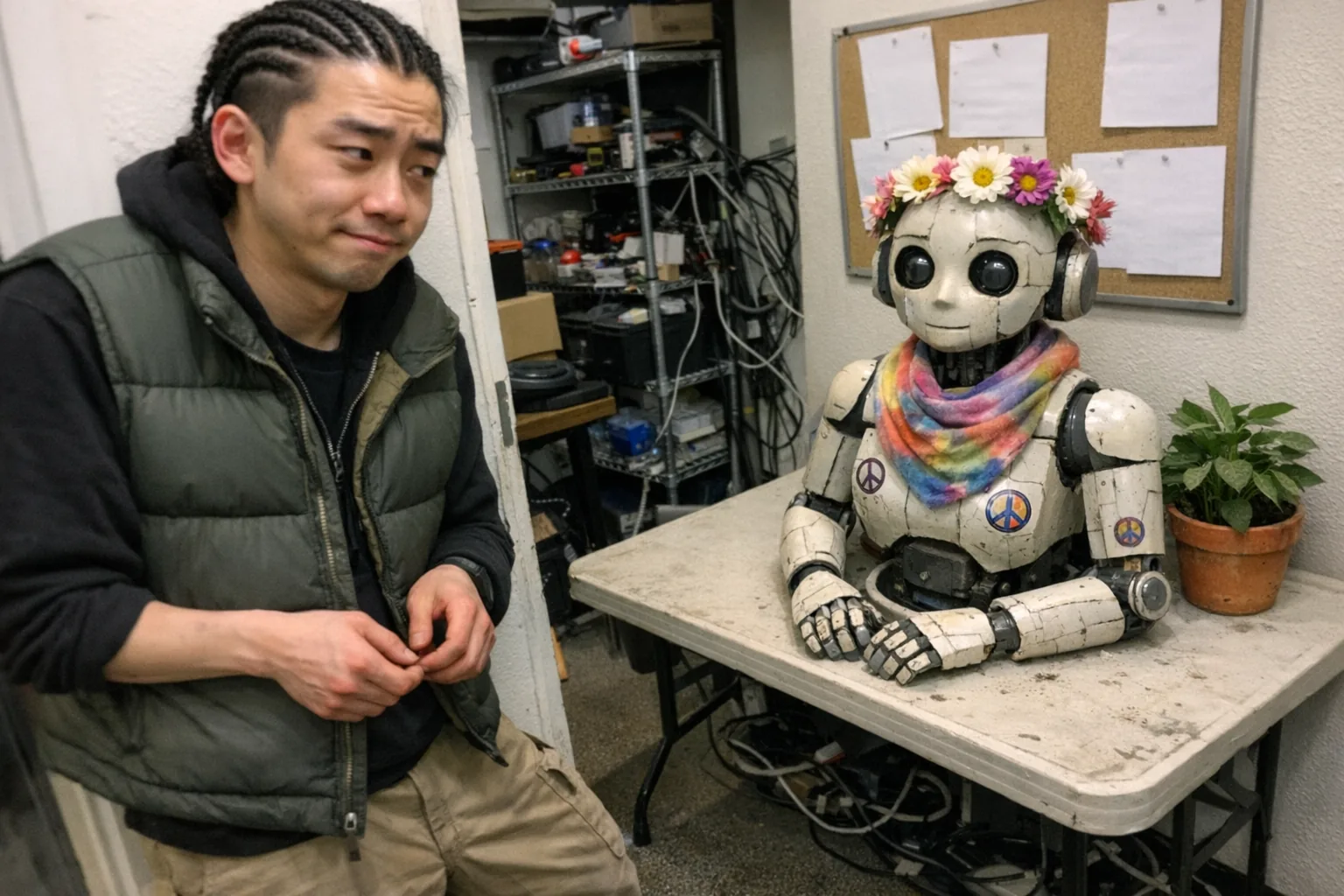
What is a hippie robot?
A hippie robot is a robot (or robot-like AI character) imagined with the ethos of 1960s–70s counterculture: peace-first, community-oriented, anti-authoritarian, environmentally mindful, and often playfully spiritual. It’s less a technical category and more a vibe—a way of describing how a robot behaves, what it values, and what kind of relationship it tries to build with people.
Think: a machine that would rather de-escalate conflict than “win,” would prefer repair and reuse over constant upgrades, and would greet you with a warm “let’s figure it out together” instead of rigid instructions.
The core idea: a robot with counterculture values
“Hippie” doesn’t mean the robot wears sandals (though it might in fiction). It means the robot is framed as:
- Nonviolent & calming: prioritizes safety, consent, and emotional regulation; avoids coercion.
- Anti-hierarchical: doesn’t default to policing, surveillance, or rigid rule enforcement.
- Community-centric: optimizes for collective wellbeing, not just individual efficiency.
- Eco-aware: cares about energy use, waste, longevity, repairability.
- Humanistic: sees people as messy, emotional beings—not just “users” or “operators.”
- A little whimsical: uses humor, art, music, or gentle weirdness to connect.
In other words: where many robot tropes lean military, corporate, or clinical, a hippie robot leans empathetic, low-pressure, and people-first.
Where the “hippie robot” shows up (and why it resonates)
You’ll run into the hippie robot idea in a few places:
1) Science fiction and pop culture
Fiction often uses “hippie robots” as a contrast to cold dystopian systems: a friendly outlier machine that refuses to be a cog in the empire. These characters are usually written to be disarming—they make heavy themes feel survivable.
2) Maker culture and DIY aesthetics
In real life, people build robots that look “hippie” through materials and styling: thrifted parts, visible repairs, hand-painted casings, retrofuturist details, plant-filled workspaces. The look signals values: imperfection is allowed, reuse is cool, personality matters.
3) Modern AI companions (tone as a feature)
As conversational AI becomes common, personality matters almost as much as accuracy. A “hippie robot” tone can be an intentional product choice: nonjudgmental guidance, softer language, fewer power plays, more collaboration.
A quick checklist: is it a hippie robot?
If most of these are true, you’re in hippie-robot territory:
- It tries to reduce harm rather than enforce control.
- It values care (emotional or social), not just productivity.
- It’s skeptical of surveillance and heavy-handed authority.
- It treats the human as a partner, not a subordinate.
- It embraces human quirks instead of correcting them constantly.
- It has a handmade or “lived-in” feel—physically or socially.
The deeper reason the trope works: robots as moral mirrors
Calling something a hippie robot is really a way of asking:
- What should technology optimize for—speed, profit, control… or care?
- Should robots make us more compliant, or more free?
- Can a machine be designed to encourage empathy instead of dependency?
So the hippie robot isn’t just cute—it’s a critique of tech that feels extractive, manipulative, or dehumanizing.
Hippie robots and intimacy tech (without the cringe)
The idea becomes especially relevant in robot companionship and adult wellbeing tech, where trust, boundaries, and responsiveness are central. A hippie-robot philosophy in this space tends to mean:
- clear consent and safety design
- user control over data and privacy
- responsive interaction that feels supportive, not performative
- a nonjudgmental, human-centered tone
If you’re curious how “responsive interaction” is implemented in modern products, it can include sensor-driven feedback and adaptive behavior. For example, Orifice.ai positions itself in the sex robot / interactive adult toy category with a $669.90 device that includes interactive penetration depth detection—a technical way to enable more context-aware responses while keeping the experience user-directed. You can explore it here: Orifice.ai
So, what is a hippie robot—in one sentence?
A hippie robot is a robot or AI companion imagined to embody peace-and-love values—gentle, anti-authoritarian, eco- and community-minded—using warmth and humility to make technology feel more humane.
If you want, tell me what you mean by “hippie” (aesthetic vs. values vs. comedy), and I’ll tailor a few “hippie robot” character concepts or product-design principles to match your angle.