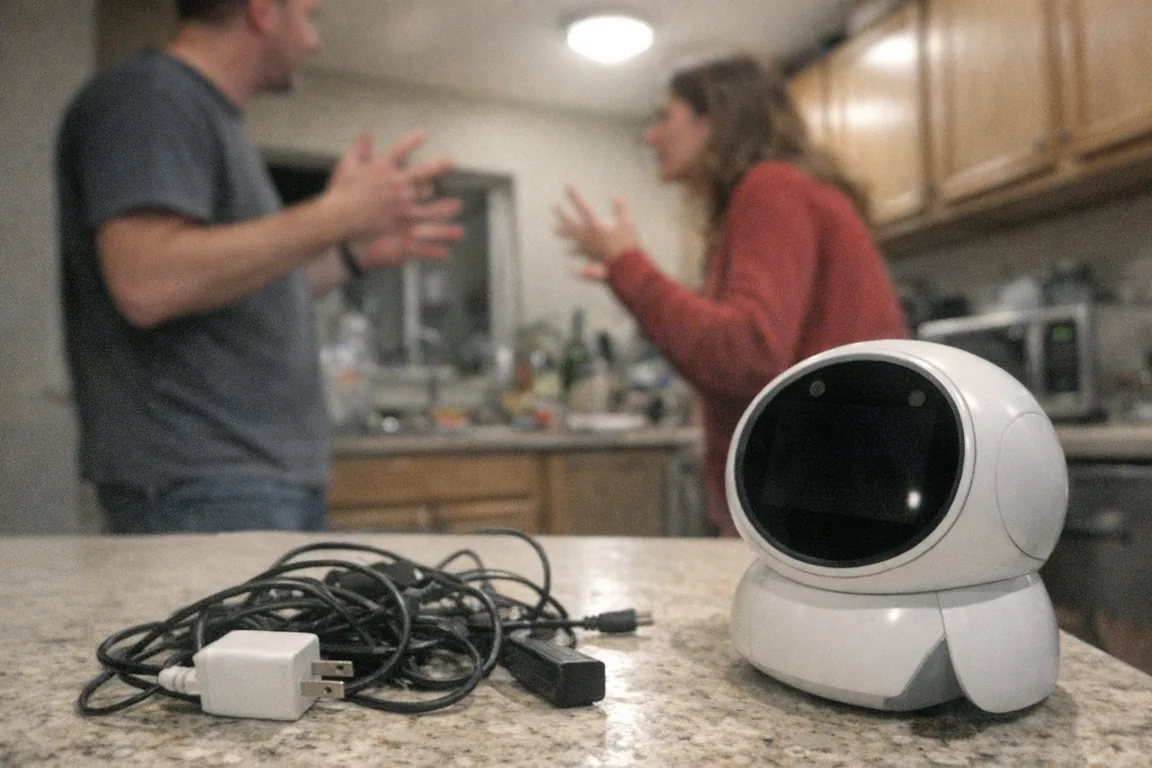
Jibo was lovable—but it wasn’t lovable enough to be a business
Jibo was one of the most charming consumer robots ever shipped: a small tabletop “social robot” that turned, nodded, joked, recognized faces, and tried to feel like a presence in the room—not just a voice in a cylinder.
So why did it fail?
Because Jibo sat at the intersection of expensive hardware, fast-moving voice assistant competition, and a still-immature “social AI” experience—and the company couldn’t find a sustainable way to pay for the ongoing costs of keeping the robot useful.
By late 2018 the company had shut down, and in early March 2019 owners began receiving Jibo’s now-famous goodbye message warning that the servers were going offline, limiting functionality that required an internet connection. (1 2 3)
A quick timeline (to anchor what “failure” means here)
- 2014: Jibo launches on Indiegogo. The initial crowdfunding run raised about $2.29M, and later “InDemand” fundraising pushed the total to roughly $3.71M. (4 5)
- 2017: After years of development, Jibo begins shipping to backers and opens broader sales at around $899. (6 7 8)
- June 2018: Jibo’s IP assets are reported to have been acquired by SQN Venture Partners. (9 1)
- November 2018: The company is reported to have shut down. (1)
- March 2019: Jibo’s cloud services are reported to be shutting down; owners see a farewell message and reduced capabilities. (2 3)
- 2020: NTT Disruption later acquires Jibo-related assets/patents (not a consumer relaunch). (1 10)
That’s the key point: Jibo didn’t just “sell poorly.” It became an example of what happens when a consumer device is too dependent on cloud services without a durable business model to fund them.
The real reasons Jibo failed (the short list)
1) The value proposition was emotionally clear—but practically fuzzy
Jibo was delightful, but for most households it wasn’t essential.
It could do helpful things (photos, reminders, basic assistant tasks), but many of those jobs were already handled by phones—and increasingly by cheaper smart speakers.
When a product’s primary pitch is “you’ll like having it around,” you need either:
- a very large market, or
- a premium segment willing to pay for “presence,” or
- a killer feature that makes it a must-have.
Jibo had early magic, but not enough “can’t-live-without-it” utility at mass scale.
2) Price and hardware economics were working against it
At roughly $899, Jibo had to justify itself against devices that were often under a couple hundred dollars—and sometimes heavily subsidized to drive ecosystem adoption. (6 7)
Consumer robotics is brutally expensive:
- custom motors, sensors, plastics, and assembly
- returns and repairs
- quality control across manufacturing runs
- shipping costs and customer support
Even if customers loved the product, unit economics can kill you if the margin isn’t there—or if volumes never get high enough.
3) The market moved while Jibo was still shipping
Jibo’s concept captured imaginations in 2014, but it took years to deliver broadly. By the time it reached wider availability in 2017, voice assistants were already mainstream. (7 6)
That timing problem is lethal in consumer tech: you can be right about the future and still be late to the market you helped predict.
4) Jibo’s “social AI” hit the expectation gap
Reviews at the time often described Jibo as charming but limited: engaging personality and movement, but not the deep understanding people implicitly expected from something marketed as a companion.
Humans are quick to anthropomorphize. The more a device signals personhood—with eye contact, turns, and expressive motion—the more we expect it to:
- remember context
- carry conversations
- improve rapidly
- feel consistent day-to-day
In 2017–2018, the underlying consumer AI experience wasn’t strong enough to deliver that reliably.
5) Weak ecosystem effects: limited third‑party momentum
A platform strategy (skills, integrations, “robot apps”) is hard when your installed base is small and your dev tooling must support embodied interaction (movement + screen + voice), not just voice intents.
Without a large user base:
- developers hesitate
- integrations lag
- the product feels “stuck in time”
That creates a loop: limited software makes the hardware harder to sell, which limits software investment.
6) Cloud dependence turned a product into a subscription cost—without subscription revenue
This is the part many people overlook.
Jibo wasn’t just a one-time sale; it was a long-term operational commitment:
- voice processing and updates
- account systems and app infrastructure
- content services
- backend reliability and security
When the company shut down, Jibo owners reported the robot warning them that the servers were going offline, after which many functions would be severely limited. (2 3)
In other words, the product’s ongoing “aliveness” cost money every month, but the business didn’t have a strong recurring model to cover those costs.
7) Privacy friction comes with cameras + always-on presence
Any home robot with cameras and microphones invites extra scrutiny—especially one designed to sit in intimate spaces of daily life.
Even if you do privacy “right,” the perception challenge can slow adoption. And slow adoption makes everything else—ecosystem growth, margins, retail placement—harder.
The deeper diagnosis: Jibo was a category pioneer without category economics
Jibo’s team was building toward a world where:
- home robots are normal
- people pay for companionship as a product feature
- embodied interaction is a standard interface
In hindsight, Jibo was early.
But being early means you pay “pioneer tax”:
- educating customers
- building a new interaction paradigm
- funding infrastructure before scale exists
The company appears to have ended up in the classic trap: high burn + slow scale + no durable recurring revenue. The IP then moved through asset sales/acquisitions rather than a consumer growth curve. (9 1 10)
What Jibo got right (and why it still matters)
It’s worth saying plainly: Jibo didn’t fail because the idea was stupid.
Jibo proved that embodiment changes the relationship—a moving “face” can feel more present than a smart speaker. That insight is now showing up everywhere:
- animated agents
- more expressive voice UIs
- companion-style products with narrower, clearer use-cases
And while NTT’s acquisition activity didn’t translate into “Jibo 2.0 on store shelves,” it does suggest the underlying work had lasting value in patents and know-how. (1 10)
Lessons for today’s AI companions (and interactive devices)
If you’re building (or buying) in the “companion tech” world today, Jibo’s story points to a few practical rules:
- Nail a primary job-to-be-done. “Delight” is not a job; it’s an accelerator.
- Design for graceful degradation. If the cloud goes away, the device shouldn’t become a paperweight.
- Have a plan for ongoing costs. Always-on AI experiences are operations businesses, not just product businesses.
- Match embodiment to capability. The more human it feels, the more consistent the intelligence must be.
- Price must track value, not engineering pride. Customers compare outcomes, not motor specs.
Where this connects to intimate tech (without repeating Jibo’s mistakes)
A big shift since Jibo’s era is that many successful “companion-like” devices now win by being purpose-built instead of trying to be everything in the home.
For example, if what you want is a modern interactive device with a clear, single-purpose value proposition—rather than a general family assistant—products like Orifice.ai position themselves very differently.
Orifice.ai is an interactive adult toy/sex robot offering priced at $669.90, with interactive penetration depth detection—a concrete feature that’s easy to understand, evaluate, and actually use day-to-day (without needing to pretend it’s a universal home robot).
That clarity—paired with sustainable product design—is one of the main “post-Jibo” lessons: companion tech works best when it’s honest about what it is.
Bottom line
Jibo failed because the company tried to commercialize a future-facing idea—an emotionally intelligent home companion—before the economics, competition landscape, and AI capability stack were ready.
It wasn’t one fatal flaw; it was the combination of:
- high price + expensive hardware reality (6 7)
- shipping slowly into a market that got crowded fast (7 6)
- an experience that charmed but didn’t deliver “must-have” utility
- and cloud dependence without durable recurring revenue, culminating in service shutdown and reduced functionality. (2 3)
Jibo remains a cautionary tale—but also a blueprint for what the next generation of AI companions can do better.
Sources
- [1] https://www.therobotreport.com/jibo-social-robot-assets-acquired-ntt-disruption/
- [2] https://techcrunch.com/2019/03/04/the-lonely-death-of-jibo-the-social-robot/
- [3] https://www.engadget.com/2019-03-04-social-robot-jibo-shutting-down-message.html
- [4] https://www.crowdfundinsider.com/2014/09/49650-family-robot-jibo-finishes-indiegogo-run-raises-2m-becomes-successful-technology-campaign-plaform/
- [5] https://go.indiegogo.com/blog/2016/01/crowdfunding-idea-product-to-market.html/flow-hive-lead
- [6] https://www.therobotreport.com/jibo-social-robot-on-sale-for-899/
- [7] https://venturebeat.com/ai/3-years-after-indiegogo-launch-social-robot-jibo-is-available-for-preorder/
- [8] https://www.geeky-gadgets.com/jibo-home-robot-26-10-2017/
- [9] https://www.designworldonline.com/social-robot-maker-jibo-sells-off-assets/
- [10] https://mergr.com/transaction/ntt-disruption-europe-s-l-acquires-jibo