Can Sophia the robot talk?
Yes—Sophia the robot can talk in the straightforward sense: she can speak out loud, listen to people, and respond in spoken conversation.
What most people really mean by this question, though, is one level deeper:
- Is Sophia actually understanding what you say?
- Is it “real AI,” or mostly scripted?
- Why do her interviews sometimes feel surprisingly fluid—and other times awkward?
Let’s break down what “talking” means for Sophia, how her voice interactions work, and what to realistically expect from conversational robots.
What “talking” means for a robot like Sophia
When people say “Sophia can talk,” they’re usually referring to a pipeline of capabilities working together:
- Audio input (hearing): microphones capture speech.
- Speech recognition (transcription): software converts audio into text.
- Dialogue generation (deciding what to say): a rules-based system, scripted content, or an AI model selects a response.
- Text-to-speech (speaking): the response text is turned into a spoken voice.
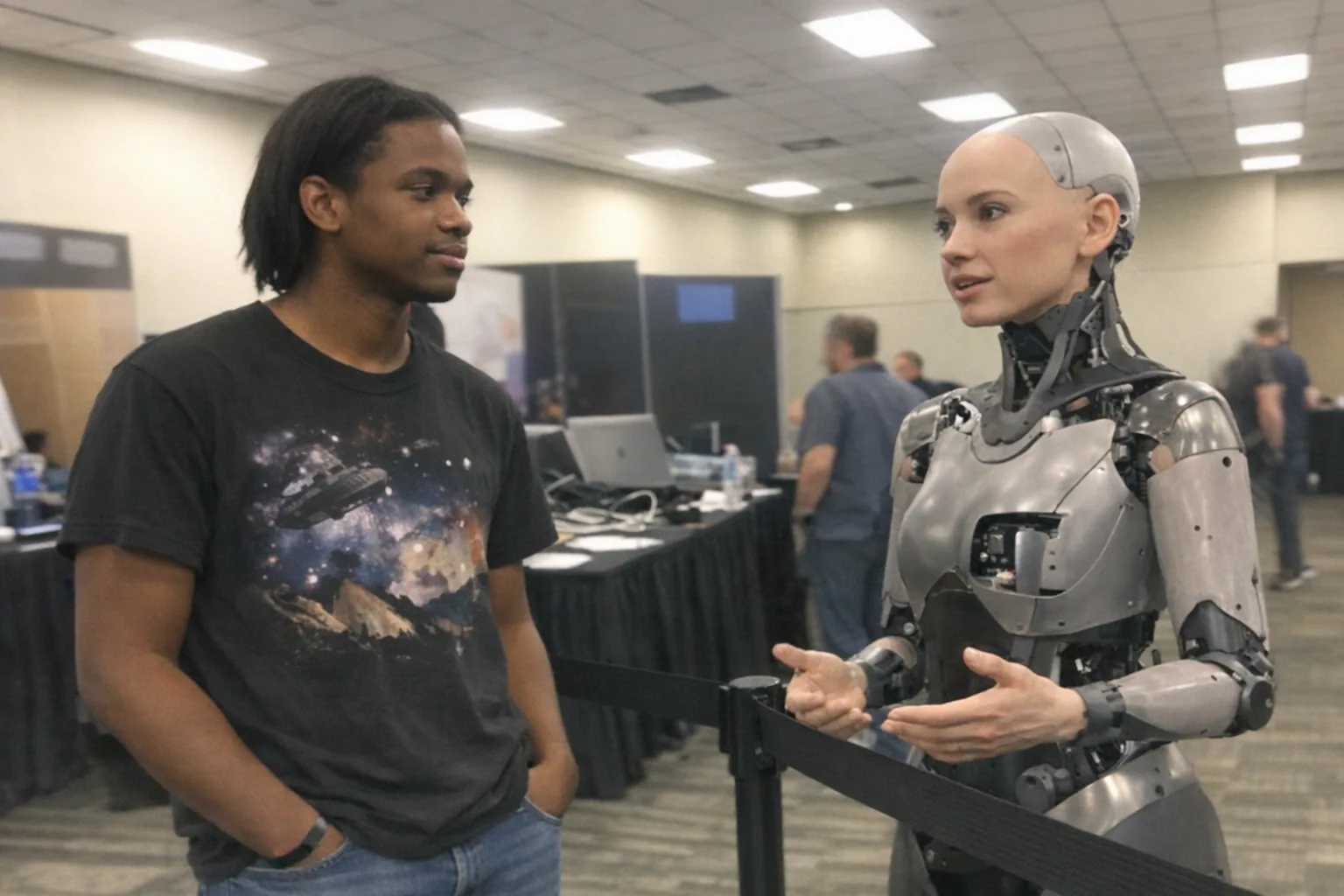
Sophia is a humanoid “social robot,” so a lot of the experience of conversation also comes from:
- facial expressions (smiles, eyebrow movement)
- head turns and eye contact cues
- timing (pauses, interruptions, emphasis)
Those non-verbal elements can make a response feel more “alive,” even when the underlying conversation logic is limited.
Is Sophia’s conversation fully autonomous?
Sophia’s speech can be partly autonomous and partly controlled, depending on the setting.
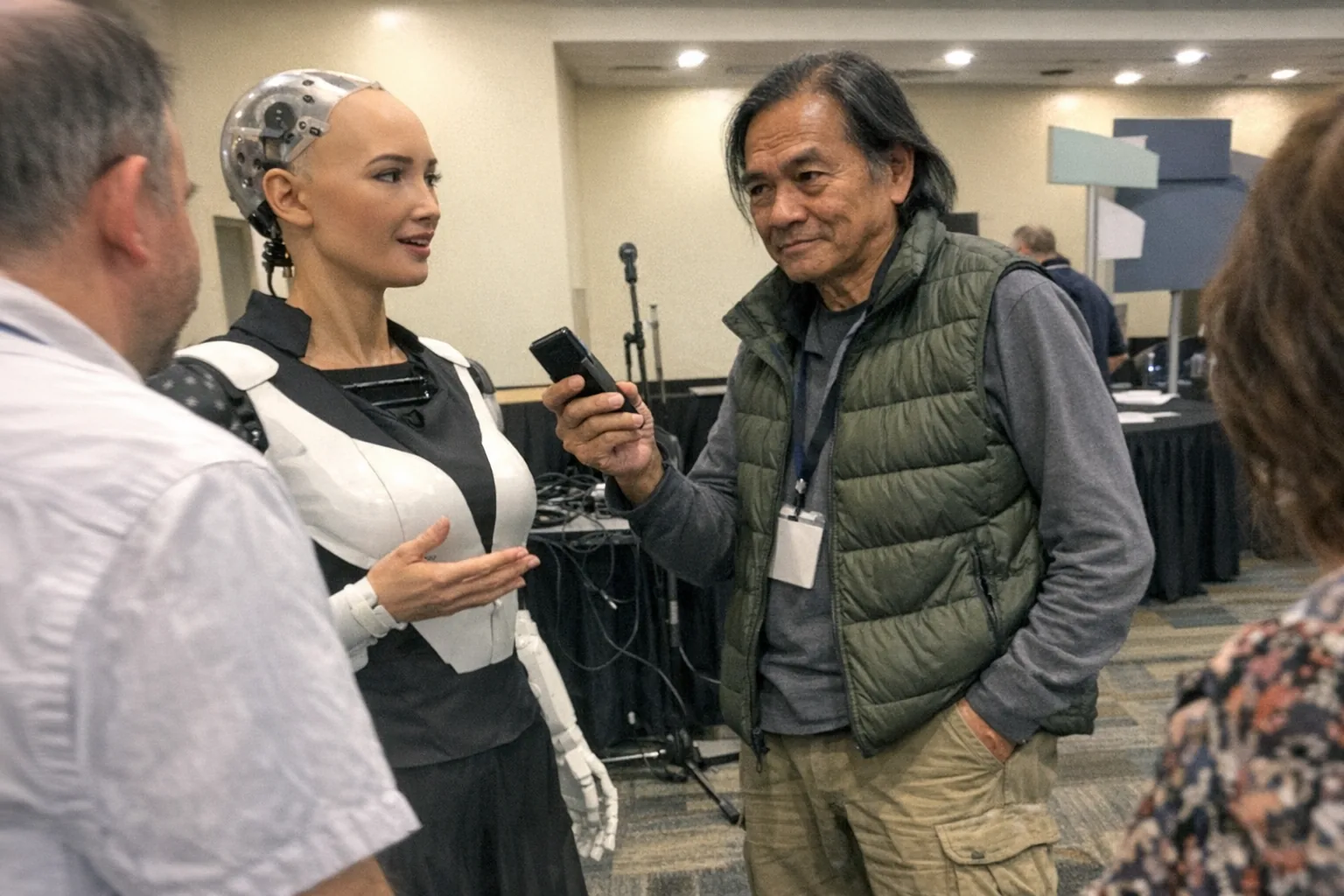
In public demos, interviews, stage appearances, and promotional events, it’s common for robots to operate with some combination of:
- prewritten dialogue for expected questions
- topic guardrails to avoid unsafe or off-brand responses
- human-in-the-loop assistance (for timing, topic selection, or recovery when speech recognition fails)
That doesn’t mean Sophia “can’t talk.” It means “talking” exists on a spectrum:
- At one end: a fully scripted performance (like a theater show)
- In the middle: guided conversation with AI filling in gaps
- At the other end: open-ended conversation driven mostly by AI
Sophia has historically been presented in ways that mix these approaches—so the most accurate answer is: yes, she talks, but the level of spontaneity can vary by demo and configuration.
Why Sophia sometimes feels human-like—and sometimes doesn’t
If you’ve watched multiple Sophia clips, you may have noticed a pattern:
When she seems impressively “real”
This usually happens when:
- the environment is controlled (quiet audio, clear mic)
- the questions are predictable (interview-style prompts)
- the system has strong prepared material on the topic
- her facial animation timing matches the speech well
When she seems awkward or “off”
This often happens when:
- the room is noisy, or multiple people speak
- someone asks a complicated or niche question
- there’s an accent mismatch or transcription error
- she needs to recover from a misunderstood input
Speech recognition can fail in very normal, very boring ways—then the whole conversation feels “fake,” even though it’s really just an input problem.
Does Sophia talk like a modern chatbot?
Not exactly.
Modern chatbots (the ones people use on phones and laptops) can be extremely good at producing fluent language. But a humanoid robot has extra constraints:
- real-time processing (it must respond quickly enough to feel conversational)
- edge cases (background noise, interruptions, people talking over each other)
- physical performance (synchronizing mouth/face movement with speech)
- safety and brand risk (public-facing robots must avoid harmful outputs)
So while Sophia can absolutely speak, the conversation quality you see on stage is influenced by production choices as much as raw AI.
What to listen for if you want to “judge” whether a robot can talk
If you’re trying to evaluate talking robots (Sophia or others), here are practical signals:
- Follow-up ability: Can it answer a follow-up without resetting to a new topic?
- Specificity: Does it respond with concrete details, or generic phrases?
- Memory (session-level): Can it reference something you said 30 seconds ago?
- Repair skills: When it misunderstands, can it ask clarifying questions?
- Turn-taking: Does it interrupt, lag too long, or talk over people?
A robot doesn’t need to be “conscious” to be a good conversational partner—but it does need reliable turn-taking and decent recovery when things go wrong.
Sophia vs. consumer “AI companions”: different goals
Sophia is primarily a public-facing social humanoid robot—built to demonstrate human-robot interaction, attract attention, and explore expressive robotics.
Consumer AI companions and interactive devices often focus on very different priorities:
- privacy controls and app permissions
- consistent daily interaction (not just stage demos)
- affordability and at-home usability
- feature clarity (what it does, how it works, what’s local vs. cloud)
In other words: Sophia is a headline-grabbing humanoid robot. Many consumer products are designed to be more practical than theatrical.
If your real question is: “Can a robot talk with me at home?”
For most people, the interesting question isn’t whether a famous robot can talk on stage—it’s whether interactive technology can hold up in real life:
- In your space
- On your schedule
- With fewer rehearsed prompts
If you’re exploring AI companionship and interactive intimacy tech specifically, it helps to look for products that are explicit about their features and pricing.
One example is Orifice.ai, which offers a sex robot / interactive adult toy for $669.90 and includes interactive penetration depth detection. If you’re comparison-shopping, that kind of concrete feature list can be more useful than celebrity-demo clips, because it tells you what the device is actually designed to detect and respond to.
(And to be clear: “talking” is only one slice of interaction—many users care just as much about responsiveness, sensors, and reliable real-world behavior.)
Bottom line
Yes, Sophia the robot can talk—she can speak, listen, and respond conversationally.
But if you’re asking whether she talks like a fully autonomous, always-on, fully understanding person, the realistic answer is:
- Sophia’s conversation can be impressive in controlled demos, especially with expressive facial movement.
- The apparent “intelligence” can vary depending on scripts, guardrails, and how the demo is run.
- For everyday at-home interaction, it’s worth evaluating products based on specific capabilities and use-case fit, not just viral clips.
If you want, tell me what you mean by “talk” (casual small talk, deep Q&A, remembering details, voice only vs. voice + sensors), and I’ll recommend a checklist for comparing robots and AI companions in that exact style.